If you’ve been tracking the Indian stock market over the last couple of years, you’ve likely seen the meteoric rise of “Railway Stocks.” At the heart of this storm sits a behemoth that doesn’t lay tracks or build engines but keeps the entire system running with the power of capital: Indian Railway Finance Corporation (IRFC).
As we move through 2026, the question on every investor’s lips is no longer just “Is IRFC a good buy?” but rather, “What is the IRFC share price target for 2026?” In this deep-dive, we aren’t just going to throw random numbers at you. We’re going to look at the mechanics, the government’s master plan, and the hard data that drives this stock.
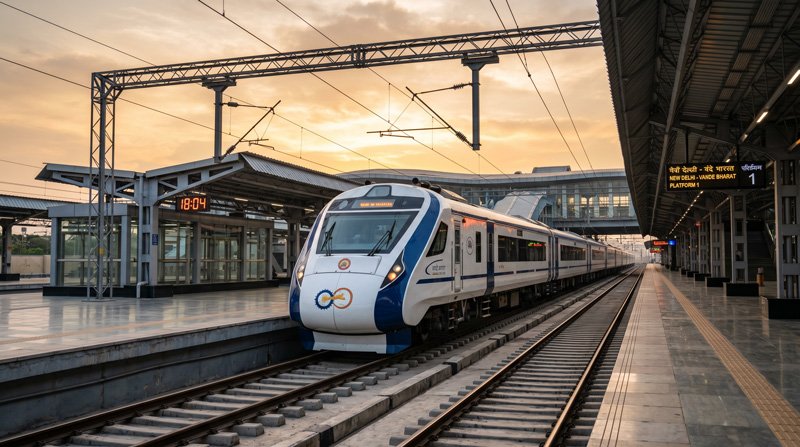
1. The IRFC Story: From a Sleepy PSU to a Market Darling
For a long time, IRFC was the stock that “never moved.” It hovered around its IPO price of ₹26 for what felt like an eternity. But then, the tide turned. The Indian government’s aggressive push toward infrastructure—specifically the modernization of the Indian Railways—acted as the high-octane fuel this stock needed.
IRFC is the dedicated funding arm of the Indian Railways. If the Ministry of Railways needs new Vande Bharat trains, track electrification, or station upgrades, they don’t just check their pockets; they call IRFC.
Why the Business Model is “Bulletproof”
One of the most unique aspects of IRFC is its 0% Non-Performing Asset (NPA) status. Think about that for a second. In a world where banks struggle with bad loans, IRFC has none. Why? Because its primary “customer” is the Ministry of Railways. The risk of the Indian Government defaulting on its own finance arm is practically zero.

- Leasing Model: IRFC buys the assets (locomotives, wagons, coaches) and leases them back to the Railways.
- The Spread: They borrow money at low rates (thanks to their AAA rating) and lease assets at a slightly higher rate. This “spread” is where the profit lies.
2. Recent Performance: A Record-Breaking Fiscal Year
To understand where IRFC is going in 2026, we have to look at the footprints it left in 2024 and 2025.
By April 2026, the data shows that IRFC has consistently outperformed its own historical benchmarks. In the financial year 2024-25, the company reported a Profit After Tax (PAT) of ₹6,502 crore—the highest in its history. Total income climbed to over ₹27,156 crore.
These aren’t just “good” numbers; they are “institutional-grade” numbers. When a company with such a massive market cap (around ₹1.37 Lakh Crore) shows steady double-digit growth in PAT, the market takes notice.
3. The “Navratna” Evolution and Diversification
2025 was a landmark year for IRFC as it officially received Navratna status. This wasn’t just a shiny title; it gave the management more autonomy to make big-ticket investment decisions without waiting for every single file to be cleared by the Ministry.
Breaking the Monolith
IRFC has started doing something it rarely did before: diversifying.
- Energy Sector: They recently sanctioned a ₹5,000 crore loan for NTPC’s capital expenditure.
- Renewable Projects: MoUs have been signed with NTPC Renewable Energy and REMCL.
- Urban Infrastructure: A massive ₹50,000 crore MoU with MMRDA (Mumbai Metropolitan Region Development Authority) highlights their expansion into urban transport and congestion-reduction projects.
This diversification is crucial for the IRFC share price target 2026. It means the stock is no longer “just a railway play”—it’s becoming a broader infrastructure finance play.
4. IRFC Share Price Target 2026: The Projections
Now, let’s get to the meat of the matter. Predicting a stock price is never an exact science, but we can build a highly probable range based on technical charts and fundamental tailwinds.
As of mid-April 2026, IRFC is trading in the ₹103 – ₹107 range. It has seen a healthy consolidation after hitting a 52-week high of nearly ₹150.
Scenario A: The Bullish Case (Target: ₹175 – ₹195)
If the government continues its Capex (Capital Expenditure) heavy approach in the upcoming budgets, and IRFC successfully integrates its new “non-railway” lending portfolios:
- The Catalyst: Successful deployment of funds into 500+ new Vande Bharat trains and the completion of the “Amrit Bharat” station redevelopment phases.
- Valuation: If the P/E ratio shifts from the current ~19x toward a more aggressive ~25x (typical for high-growth infra NBFCs), we could see the price testing the ₹180 mark by late 2026.
Scenario B: The Base Case (Target: ₹135 – ₹155)
This is the most realistic scenario. It assumes steady growth without any massive “fireworks.”
- The Catalyst: Routine leasing growth and maintaining the 1.5% – 2.5% dividend yield.
- Valuation: A steady climb back toward its 52-week highs, supported by quarterly earnings growth of 10-12%.
Scenario C: The Bearish Case (Target: ₹85 – ₹100)
Every investor should be aware of the “downside.”
- The Catalyst: An “OFS” (Offer for Sale) where the government offloads more stake, creating a temporary supply glut in the market. Or, a global spike in interest rates that narrows IRFC’s borrowing spreads.
- Valuation: The stock may consolidate or trade sideways in the double digits if the market feels the PSU rally has reached its saturation point.
5. Technical Analysis: The Chart Speaks
Looking at the weekly and monthly charts for 2026, IRFC shows a classic “rounding bottom” or “cup and handle” formation in the making.
- Support Levels: Strong support is visible at ₹88 – ₹92. As long as the stock stays above this, the long-term uptrend remains intact.
- Resistance Levels: The immediate hurdle is ₹120. Once the stock crosses this with high volume, the path to ₹150 is wide open.
- RSI & MACD: In April 2026, the RSI (Relative Strength Index) is hovering around 50, suggesting the stock is neither overbought nor oversold. It’s in a “wait and watch” zone, making it an interesting entry point for long-term players.
6. The Dividend Factor: Why IRFC is a “Pension” Stock
For many retail investors, IRFC is like a “post office savings scheme” that trades on the stock market. The company has a consistent track record of sharing its profits.
In October 2025, IRFC declared a record interim dividend of ₹1.05 per share. If you are holding a large quantity, these payouts add up, effectively lowering your “cost of purchase” over time. With a dividend yield that often sits between 1.5% and 2%, it offers a better return than most savings accounts while providing the potential for capital appreciation.
7. Risks You Can’t Ignore
We wouldn’t be doing our job if we only talked about the upside. Investing in IRFC comes with specific risks:
- Government Stake Sale (OFS): The government still holds a massive stake. To meet SEBI’s public shareholding norms, they may sell more shares. Historically, an OFS leads to a temporary price dip.
- Interest Rate Sensitivity: Since IRFC’s business is borrowing and lending, high interest rates can squeeze their margins, although their cost-plus model usually mitigates this.
- Sectoral Concentration: Despite diversification, over 90% of their business is tied to the Railways. Any change in government policy toward railway privatization or funding could impact IRFC.
8. Comparison: IRFC vs. RVNL vs. IRCON
When looking at the IRFC share price target 2026, it’s helpful to see where its siblings stand.
| Stock | Role | Risk Profile | Yield |
| IRFC | Financier | Ultra-Low (0% NPA) | High |
| RVNL | Execution/Construction | Medium | Moderate |
| IRCON | International/Construction | High | Moderate |
While RVNL and IRCON often give higher percentage “pops” during a rally, IRFC is the steady turtle that wins the race with lower volatility.
9. Final Verdict: Should You Invest?
As we look toward the end of 2026, IRFC remains a cornerstone for any “India Growth Story” portfolio. It is not a stock for day traders looking to double their money in a week. It is a stock for the patient investor who understands that India cannot grow without its Railways, and the Railways cannot grow without IRFC.
The Bottom Line: The IRFC share price target 2026 is anchored by solid fundamentals, a “Navratna” status that allows for diversification, and a government that is obsessed with infrastructure. A target range of ₹140 to ₹165 seems highly achievable, with the potential for more if the diversification into green energy takes off.
Frequently Asked Questions (FAQs)
1. What is the IRFC share price target for 2026?
Based on current financial trajectories and technical analysis, the target for 2026 is projected to be between ₹135 and ₹185, depending on market conditions and government policy.
2. Is IRFC a debt-free company?
No. In fact, IRFC has high debt because its entire business model is based on borrowing money from the market to lease assets. However, this debt is considered “safe” because it is backed by the Ministry of Railways.
3. Does IRFC give good dividends?
Yes, IRFC is known for its consistent dividend payouts. In FY 2024-25, it paid out a total of ₹2.00 per share across multiple intervals.
4. Can IRFC reach ₹200 by 2026?
While ₹200 is a psychological milestone, it would require a significant re-rating of the PSU sector or an extraordinary jump in earnings from their new diversification projects. It is a “Bull Case” possibility but not a guaranteed base-case.
5. Why is IRFC share price falling in 2026?
Stocks don’t move in a straight line. After the massive rally of 2024, the stock is in a “consolidation phase” where early investors are booking profits. This is generally considered healthy for a long-term uptrend.
Disclaimer: This article is for educational purposes only. Stock market investments are subject to market risks. Please consult with a certified financial advisor before making any investment decisions.

Other Articles
Best Shares to Buy Today for Long Term in India